

CECILIA VICUÑA COMES TO WHITECHAPEL GALLERY FOR MAJOR UK EXHIBITION
Whitechapel Gallery will present the first major UK exhibition of Cecilia Vicuña, one of Latin America's most internationally renowned artists, poets and feminist activists. Spanning six decades, the exhibition brings together Vicuña's interdisciplinary practice across painting, textiles, photography, installation, film, poetry, performance and ritual, exploring the powerful connections between art, politics, environmentalism and indigenous knowledge.
First major UK exhibition of the internationally acclaimed Chilean artist, poet and feminist activist explores six decades of art, politics, poetry and environmentalism.
The exhibition opens with Quipu Menstrual (2006–2024), a striking sculptural installation made from un spun wool in vivid shades of red and brown suspended from the ceiling. Vicuña has been creating quipus for more than 50 years, drawing on the ancient Andean system of knots traditionally used to encode knowledge and communicate messages through intricate arrangements of threads and colour.
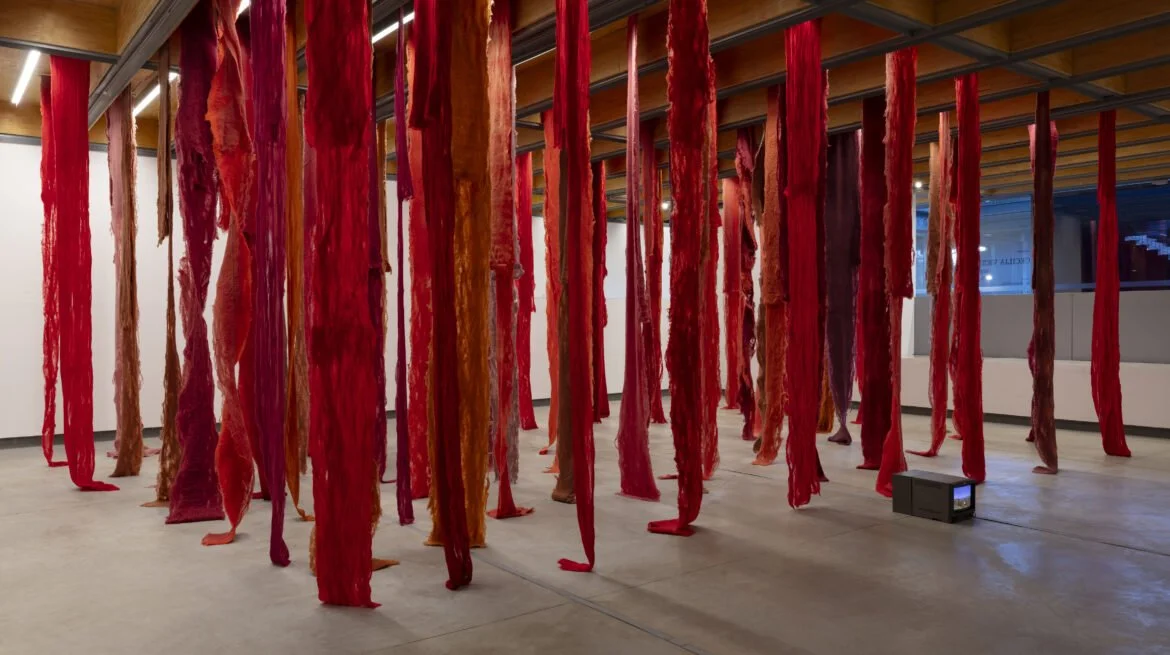
Cecilia Vicuña, Quipu Menstrual 1 (unknotted), 2006 / 2024. Photo Isabella Matheus
Born in Santiago, Chile, in 1948, Vicuña came to London in the early 1970s to study at the Slade School of Art, where she had a studio in Stepney Green. Her time in the capital marked a defining period in her artistic development. Following the violent military coup against President Salvador Allende in 1973, Vicuña self-exiled in London, where her experiences of displacement, political violence, loss and instability intensified the political dimension of her work.
London's politically charged art scene of the early 1970s, which brought together artists, activists and liberation movements from around the world, became an important backdrop to Vicuña's practice. In 1974, she co-founded Artists for Democracy with David Medalla, John Dugger and Guy Brett, an organisation created in solidarity with Chile and other liberation struggles worldwide.
For Vicuña, the quipu becomes a living symbol of memory, resistance and indigenous knowledge. Quipu Menstrual grew from her 2006 performance The Blood of Glaciers / La sangre de los glaciares, in which she carried red wool threads to Chile's El Plomo Glacier, drawing a symbolic connection between menstrual blood and melting ice, two vital and cyclical forces under threat.
A central theme throughout the exhibition is Vicuña's commitment to protecting ecosystems and preserving indigenous systems of knowledge. Her work considers the destruction of the natural world and the erasure of indigenous communities as interconnected forms of violence, while looking towards their recovery as a way of imagining alternative futures.
The exhibition also features Vicuña's celebrated precarios, small and deliberately fragile sculptures made from found and discarded materials. First created in the mid-1960s, these 'spatial poems' were originally placed on beaches for the tide to erase, challenging traditional ideas of sculpture as permanent or fixed. Among the works on display is Precarios: A Journal of Objects for the Chilean Resistance (1973–74), the only surviving group of precarios from Vicuña's London period, shown alongside archival documentation of the 400 works from the collection that were lost.
Vicuña's work as a poet and painter is equally central to her practice. Paintings created during her time in London in the 1970s are presented alongside subsequently repainted works that were lost, as well as a recent series continuing her exploration of indigenous knowledge and cultural memory.
The exhibition also explores Vicuña's long-running engagement with public performance and intervention. What is Poetry to You? (1980), filmed in Bogotá, presents a series of encounters in which Vicuña asks people from different walks of life the same question: 'What is poetry to you?' The responses transform poetry into a communal and political force, demonstrating its ability to connect people and challenge established ideas.
Another highlight is the Palabrarmas series, including the 28 pencil-and-paper works AMAzone Palabrarmas (1978). Combining the Spanish words for 'words' (palabras) and 'weapons' (armas), the works break language apart and reconstruct it to reveal new meanings. Vicuña began the series in London in 1974, imagining language itself as a nonviolent weapon against the brutality of military dictatorships across Latin America.
The exhibition concludes with Ciudad Geométrica (2025), a new large-scale installation presented in the UK for the first time. Constructed from ephemeral materials including driftwood, feathers, shells and bones collected in Belgium, Chile and New York, the work creates a minimalist 'geometric city'. Drawing on Vicuña's original architectural training and the sculptural principles of pre-Hispanic Andean architecture, the installation presents an alternative form of world-building while reflecting on fragility, disappearance, endurance and renewal.
Together, the works demonstrate why Vicuña has become such an influential figure in contemporary art. Her practice continually questions conventional ideas of permanence, language, sculpture and authorship, instead creating poetic spaces in which environmental, political and cultural histories can be reconsidered.
Cecilia Vicuña is presented in partnership with the Irish Museum of Modern Art, Dublin, where the exhibition is currently on display until 5th July 2026, before travelling to Whitechapel Gallery.
Cecilia Vicuña runs at Whitechapel Gallery from 7th October 2026 - 14th February 2027. The exhibition will be ticketed.